
Impulse spending comes up a lot in my coaching sessions, and it's the topic I most enjoy working on. Most impulse buys don't feel like a decision when they happen. Someone is scrolling late at night or has had a long day, the "pay in three" option is right there, and the order goes through before they've really thought about it.
When impulse buying happens
When clients look back over their spending with me, the same times tend to come up. Late evenings, Friday afternoons, payday, the end of a difficult week, or a weekend with nothing much planned. The spending usually follows how someone was feeling at the time, tired, stressed, bored or feeling they'd earned a treat.
Buying something does give a lift, but a lot of that comes from the browsing and looking forward to it arriving. By the time the parcel turns up, the feeling has often gone, which is why the urge comes back so quickly.
Impulse buy bingo
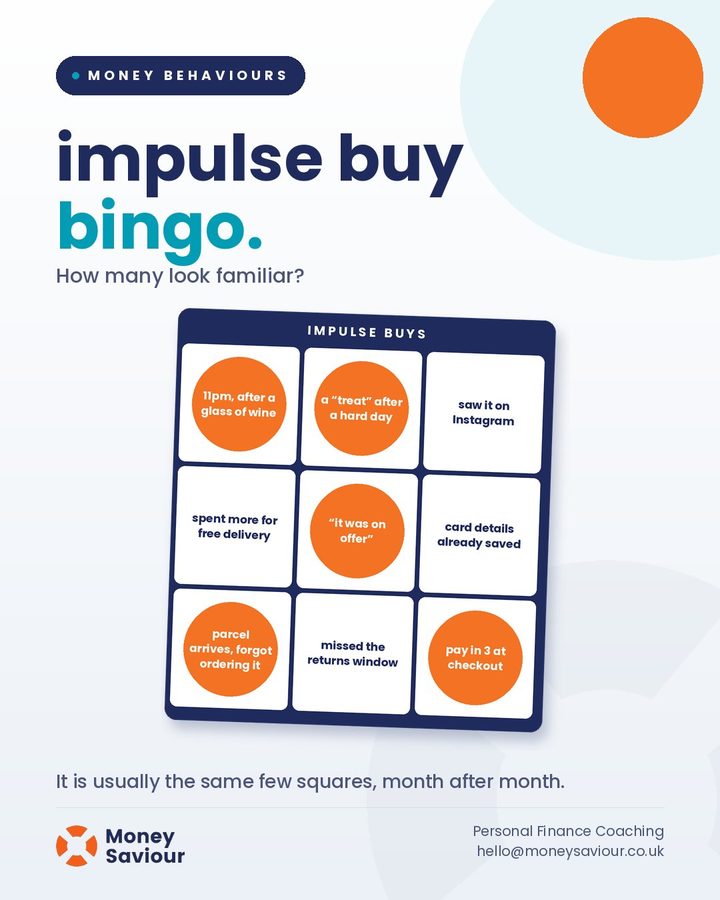
How many of these do you recognise? Shopping at 11pm after a glass of wine, a "treat" after a hard day, spending more to get free delivery, card details already saved, pay in three at the checkout. Most impulse buys start with one of these. None of them is a problem on its own, but when the same squares come up week after week, the cost soon builds, and it often goes unnoticed until the bank statement arrives.
When the budget is too tight
Sometimes what looks like impulse spending is really a budget that doesn't add up. I often see budgets with nothing set aside for birthdays, haircuts, school trips, the car's MOT or the odd meal out, as if they'll never come up. They always do, so the budget is broken within a couple of weeks, and the person feels they've failed when the plan was never realistic in the first place.
A budget that's too strict can also backfire in the same way a strict diet does. Going without for weeks tends to end in a bigger spend, followed by guilt and another attempt to cut right back. A realistic budget, with room for the things that always come up and some money for things you enjoy, is much easier to stick to.
When money feels scarce
When money has been tight for a long time, it changes how people think about it. It's hard to plan for next month when you're focused on getting through this one, and that's a natural response rather than a lack of willpower. Some people spend as soon as money arrives, because it feels safer to use it while it's there, or because they're used to it disappearing anyway. Others feel they've gone without for so long that they deserve something when there's a bit spare.
None of this means someone is careless. It's a reaction to pressure, and it usually eases once there's a plan that gives a bit of breathing space.
Small amounts add up
Most people are careful with big purchases but don't think twice about £4.99 or £12. Those amounts feel too small to count, so they don't get looked at. Over a month, though, they're often where a lot of the money has gone.
Paying by card or phone also makes it easier. Handing over cash makes you notice what you're spending, whereas tapping a phone or using saved card details hardly registers. Splitting a cost into instalments makes it feel smaller again. Shopping sites know this, which is why they save your details, offer one-click checkout and tell you there are only two left.
"I deserve it"
I hear this a lot, and treats are fine. Cutting them out completely rarely lasts. It becomes a problem when spending is the main way of coping with a bad day, or when doing something good, like going to the gym, turns into a reason to spend.
Guilt plays a part too. After spending more than planned, people often stop checking their banking app because they don't want to see it. That makes it even easier to lose track, and it's often around this point that someone tells me they're "just bad with money". In my experience that's very rarely true. It's usually a habit that has built up over time.
Keeping a spending diary
One of the tools I use most with clients is a spending diary. For two to four weeks, you write down everything you spend, however small, along with the time, where you were and how you were feeling. It takes a few minutes a day, and it isn't about judging yourself.
Bank statements show what was spent. A spending diary shows why. Most people are surprised by what they find, whether it's the same few times of day, a particular mood or a regular cost they'd forgotten about. It also shows whether the budget itself is realistic.
In coaching, we go through the diary together. That's usually where the real patterns show up, and where we start building a plan around them.
How to stop impulse buying
Removing saved card details from shopping websites means you have to go and find your card, and that's often enough time to change your mind. Waiting 24 hours before buying anything you hadn't planned works in a similar way. Turning off shopping app notifications and unsubscribing from sale emails means fewer prompts to spend in the first place.
It's also worth asking yourself what you actually need in that moment. If it's rest or a break from a stressful day, there may be something else that helps more.
Planning for treats helps as well. If you decide at the start of the month how much you're happy to spend on things you enjoy, you can spend it without feeling guilty, and you're less likely to overspend later.
If it's more than the odd treat
Sometimes impulse spending is part of a bigger picture, perhaps a busy life, stress, or never having had a plan that really fits. Personal Finance Coaching looks at the habits behind spending and helps you build a plan that works for you, with support to stick to it. It's guidance and education rather than regulated financial advice, and I don't sell or recommend products. It starts with a free 10-minute call.
If you're already struggling with debt, free and confidential advice is available from MoneyHelper, Citizens Advice and StepChange.
See the coaching options, or read It's not just Christmas: the spending that builds from summer.
General information, not advice. Personal finance coaching is provided by Money Saviour Financial Solutions Ltd and is not regulated by the FCA. Debt advice is provided by Money Saviour C.I.C. through commissioning organisations only.